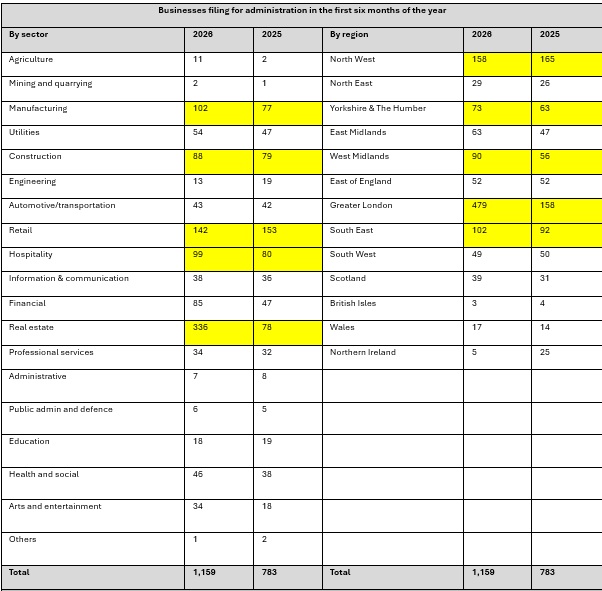


Business failures in the South East have continued to rise, with 102 companies filing for administration in the first six months of 2026 – up from 92 during the same period in 2025, according to analysis by South East law firm Mayo Wynne Baxter.
The South East was the UK’s third worst-hit region for administrations during the first half of 2026, behind only Greater London (479) and the North West (158).
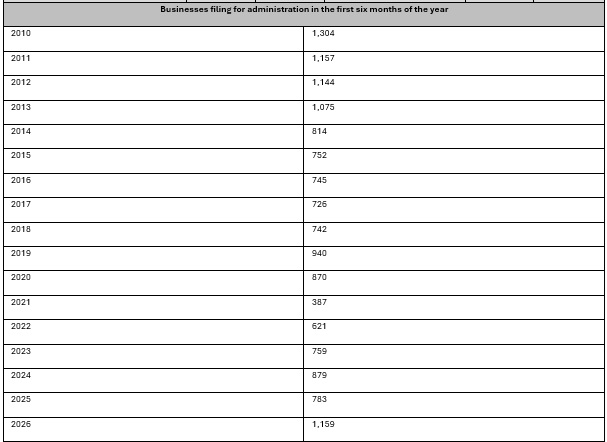
Analysis of data from The Gazette Official Public Record forms part of a wider national picture, which saw UK administrations reach their highest level since 2010.
Across the country, 1,159 companies entered administration in the first six months of 2026 – a 48% increase from the 783 recorded during the same period in 2025. The total also marks the first time administration volumes have exceeded pre-pandemic levels (940 in 2019).
Nationally, the real estate sector experienced the most significant increase, with administrations rising more than four-fold from 78 in the first half of 2025 to 336 in 2026.
Retail remained under considerable pressure despite a slight year-on-year improvement, recording 142 administrations compared to 153 in 2025. Manufacturing (102, up from 77), hospitality (99, up from 80) and construction (88, up from 79) completed the five worst-affected sectors. The hospitality industry came under notable pressure in January, with 32 administrations recorded during the month, 22 of which related to pubs and bars.
Elsewhere, the financial sector recorded a sharp increase from 47 to 85, while the arts and entertainment industry almost doubled from 18 to 34.
The figures include several high-profile corporate failures – including car parking firm NCP – and reflect the administration of hundreds of special purpose property companies in Greater London linked to the collapse of bridging lender Market Financial Solutions.
Nick Stockley, dispute resolution partner at Mayo Wynne Baxter, said: “The South East has seen administrations continue to rise during the first half of the year, making it the third worst-hit region in the UK. While the increase is far less dramatic than that seen in London, it reflects the ongoing financial pressures facing businesses across the region.
“Many businesses have spent the past few years absorbing higher borrowing costs, inflationary pressures and increased operating expenses. While inflation has eased from its peak, the cumulative impact of those challenges, combined with subdued economic growth and cautious consumer spending, is now feeding through into administration numbers.
“The fact that administrations remain at these levels shows many businesses have simply run out of options after several years of sustained pressure.”
Geographically, Greater London once again became the UK’s insolvency hotspot, with administrations tripling from 158 in the first half of 2025 to 479 in 2026.
The North West remained the second worst-hit region despite a slight fall from 165 to 158 administrations, while the South East (102, up from 92), West Midlands (90, up from 56) and Yorkshire & The Humber (73, up from 63) completed the top five.
Nick said: “At first glance, the national figures suggest an extraordinary deterioration in both the real estate sector and Greater London. However, it’s important to recognise that a substantial proportion of those appointments involve hundreds of special purpose property companies connected to the collapse of Market Financial Solutions.
“Those appointments have heavily influenced the totals for both the sector and the capital but they should not distract from the broader picture. Businesses across the South East continue to grapple with weak economic growth, higher employment costs, refinancing pressures and subdued consumer demand.
“The fact we’ve seen high-profile failures such as NCP also demonstrates that financial distress is affecting well-established businesses, not just smaller operators or individual sectors.”
Despite some sectors and regions proving more resilient than others, Nick warned businesses to act early if they encounter financial distress.
He said: “Whether or not individual large failings have influenced the headline figures, there is no escaping the fact that the business environment remains incredibly challenging. Cost pressures remain high, refinancing is becoming increasingly difficult for some businesses and confidence continues to be fragile.
“Our advice remains unchanged – seek professional advice early. Directors who act at the first signs of financial difficulty have far more options available to restructure, protect value and, where possible, rescue the business. Waiting until cashflow becomes critical can significantly reduce those options.”